Mobility Reserve
Before it's a limit
The garden, the long walks, the grandkids on the floor.
That's a list you'd hate to lose. 10 minutes a day is how you choose.
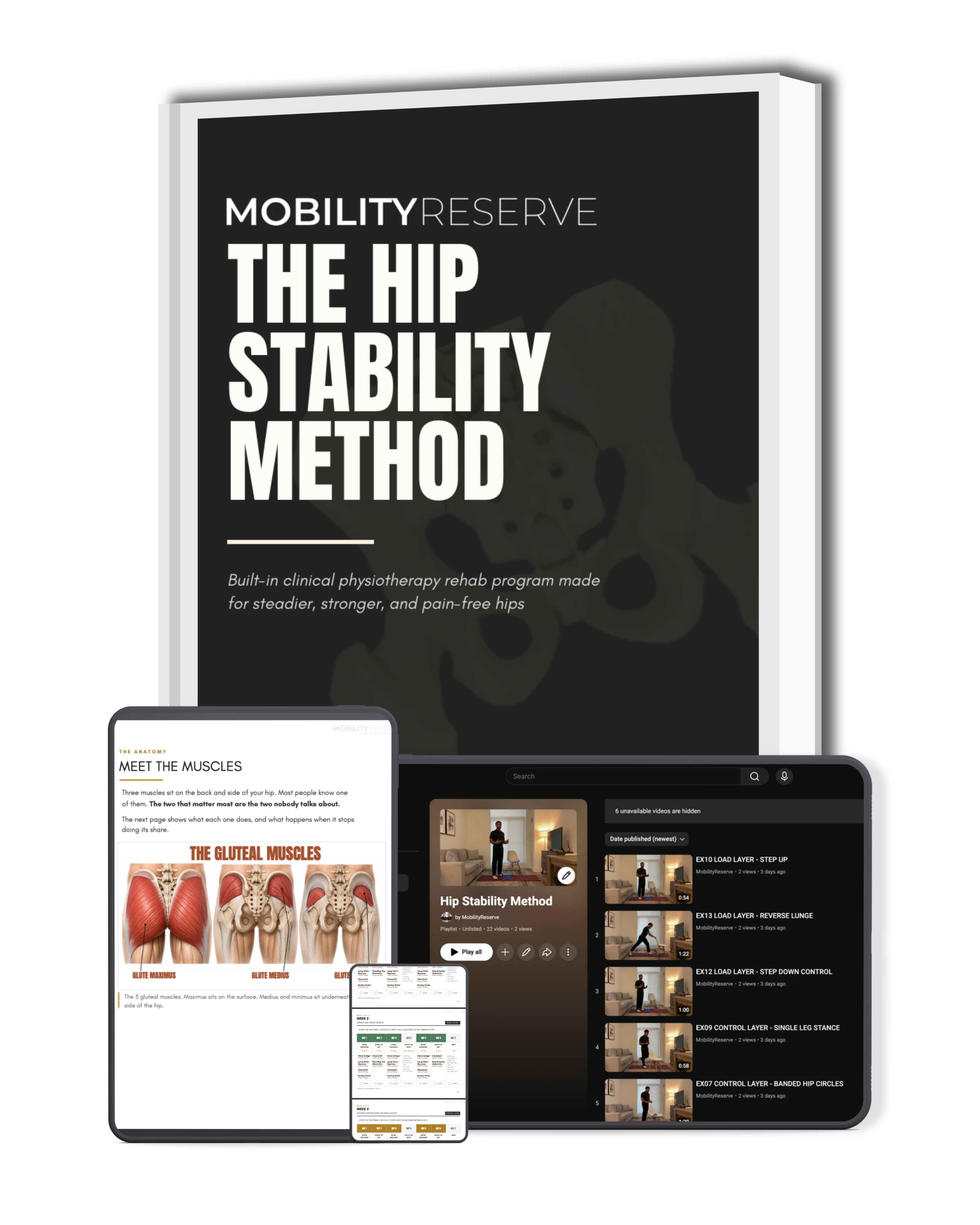
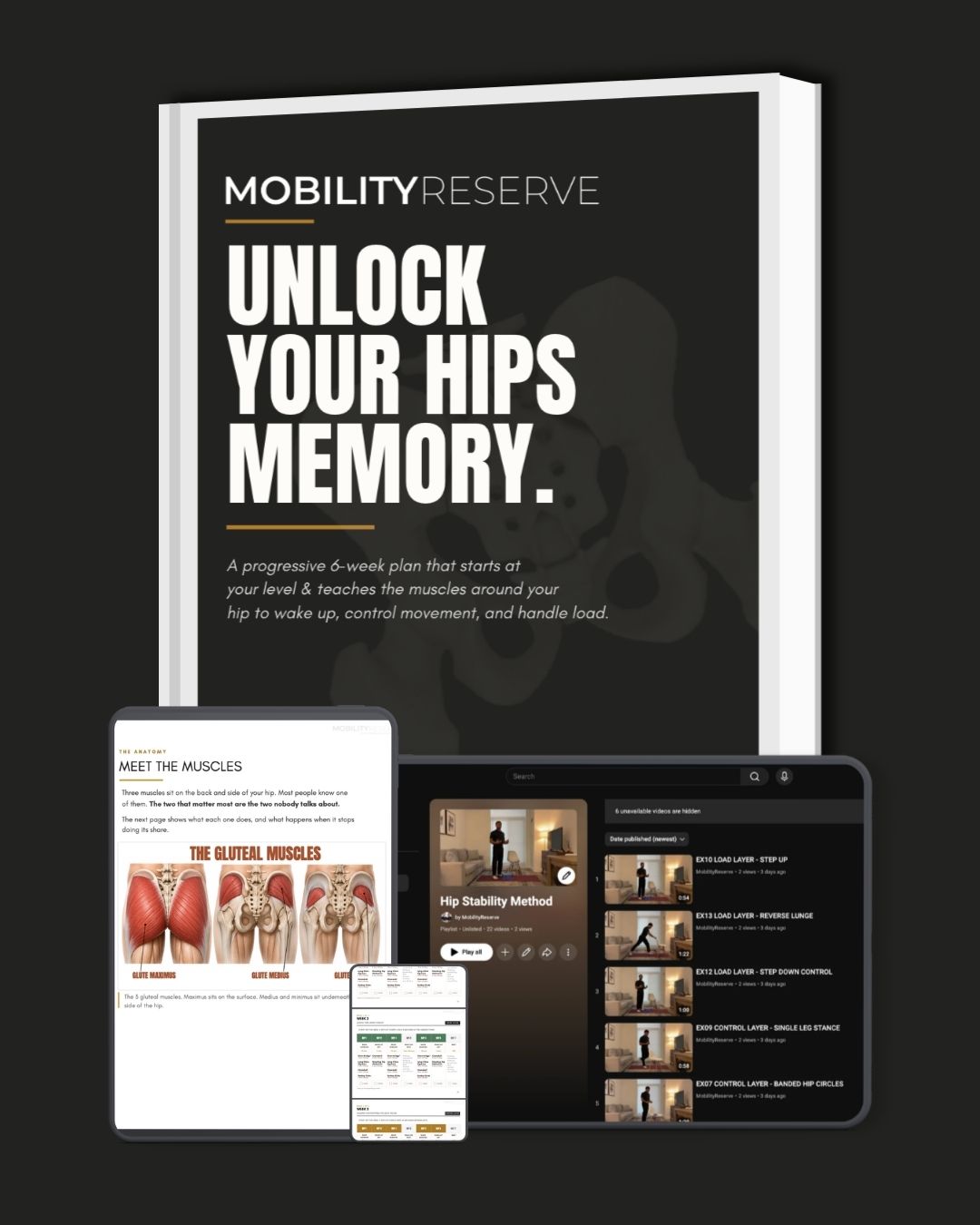
Stop guessing which hip exercises to do. Follow a guided progressive 6-week plan that starts at your level and teaches the muscles around your hip to wake up, control movement, and handle load.
Developed by Physical Therapists
Instant PDF download with printable tracker
Avoid pills, injections, and surgery
No prior experience needed
Simple equipment · Less than 15 minutes per day · Built for every starting point
Does this sound familiar?
If any of these resonate with you,
you're in the right place.
Have you tried heat, ice, stretching, massage, creams, pills, and even exercises you have seen online?
You feel great for 12-48 hours, but then you end up back to where you were before.
Does it hurt somewhere it shouldn't?
Your knee hurts on the stairs. Or your back aches after you've been standing a while. Tests came back fine, and no one can tell you why.
Have you watched a lot of videos, but you still don't have a plan?
One for hips. One for balance. One for knee. They all made sense on their own. None of them told you what to do next.
Not trying to be young again? Just trying to keep what you have?
The garden. The trips. Getting down on the floor with the grandkids. You want to keep doing all of it, and you'd rather start now.
Haven't made a fuss, because you don't want to need help?
You hold the rail. You don't say much about it. You'd rather sort this out yourself, and that's fair.
The research
80% of adults over 65 aren't doing the one thing that keeps hips and knees strong
of U.S. adults 65+ meet the CDC’s strength training guidelines.
Source: American Heart Association, 2024
Strength doesn’t disappear all at once. It tends to go quietest around the hips and knees first. A harder push out of a low chair, a stair rail you didn’t used to reach for, ground that feels a little less trustworthy underfoot. None of it hurts yet. That’s what makes it easy to miss.
By the time something does hurt, a lot of that strength is often already gone. Which is why the fix isn’t waiting for a diagnosis, it’s rebuilding the strength before you need it.
You don’t need a full gym program to turn that around. You need a starting point built specifically for bulletproofing your back, hips and knees, which is what Wake, Control, and Load are for.
This isn't designed to get you all the way to that guideline on its own. It's designed to help you regain the motivation, the strength, and the belief that getting back to your regular activities and eventually that guideline itself is possible.
General population data; individual results will vary.
What to expect
How the six weeks are built
Wake
WEEKS 1-2
Start by getting the right muscles to switch on with light, controlled work. This is the phase where being consistent matters most.
Control
WEEKS 3-4
Train your hip to hold the pelvis steady while the rest of your body moves. This is where the work starts asking more of you.
LOAD
WEEKS 5-6
Build strength that carries into stairs, walking, sport, and real life. Build strength that carries into stairs, walking, and the things you do every day.
WHO BUILT THIS?
We're two registered physiotherapists. Between us we've spent years in private practice, and before that, in the intensive care unit (ICU) at our local hospital.
The ICU is where you learn how fast independence disappears. One fall, one bad week, and someone who was walking out to the mailbox on Monday needs help standing up on Friday. Most of us never think about our independence until the moment it's gone. That part stays with you.
Now we see the earlier version of that story every day in clinic. Someone comes in walking a little more carefully than they did last year. They've stopped taking the stairs. They've stopped going out in winter. And somewhere along the way, someone they trusted told them to slow down and be careful.
Careful doesn't make you stronger. It just makes your world smaller.
So we kept refining what actually helped. Which exercises, in what order, and when a person is ready for more. That's what this program is: the order we use.
We built this program because we can't fit everyone into a clinic schedule, and because the 90,000 people who follow us kept asking for a plan instead of another exercise.
It isn't a personal assessment and it isn't meant to replace one. It's what we do at work, written so you can do it at home. A few minutes a day, in the right order, is enough to start.
- Peter, PT & Terence, PT

You can be active and still be weak in the places that
keep you steady.
The muscles on the side of your hip keep your pelvis level when you walk.
Most exercise, in the gym or out of it, moves you forward and barely uses them.
So they can weaken for years without you knowing.
When they stop pulling their weight, your back and your knee do the job instead. You feel it there. It did not start there.
Often it shows up in small ways first. The dog walk gets shorter. You wait for the low step. You stop getting down on the floor with the grandkids, because getting back up is the hard part.

YOU'RE PROBABLY THINKING
"can't i just find these exercises online?"
This is probably a thought that is going through your head right now.
Our free posts give you one exercise at a time. Each one is useful. But they don't tell you which one to do, how hard to make it, or what to do next. You still have to figure that out.
That's why most people stop making progress. The work never gets harder. Your body gets used to it and stops changing.
The Hip Stability Method does that part for you. A short test shows you your level. Then you follow six weeks in order: Wake, then Control, then Load. Each week builds on the one before.
You don't build the plan. You just follow it.
A single physical therapy visit costs 75$ or more.
This is $37, once, and it's yours to keep.
The order, the levels, and the coaching cues are only in the guide.
|
Free Online Content
|
Hip Stability Method
|
|
|---|---|---|
|
Cost
|
$37
|
|
|
What You Get
|
Structured 6-week program
|
|
|
Where to Start
|
Baseline tests to determine difficulty level
|
|
|
Difficulty
|
3 levels for each exercise
|
|
|
Progression
|
Wake → Control → Load
|
|
|
Form Correction
|
Coaching cues with common mistakes for each exercise
|
What if I am not fit enough to start?
Every exercise has three levels, so you begin where you actually are - not where a one-size-fits-all program says you should be.
No complicated gym setup.
A chair, step, wall, and optional resistance bands cover the program.
No guessing when to progress.
Three starting-point checks and clear progression guidance tell you what to do next.
No hour-long workouts.
The program is designed around <15 minute sessions across the week.
No need to give up your normal activities
The program is designed to sit underneath walking, sports, or gym work rather than replacing it.
WHAT YOU GET
Everything laid out for you.
6-week day-by-day calendar
Each week tells you exactly which exercises to do, with sets and reps.
5-minute starting-point check
Three simple checks help you choose your starting level before Week 1.
Pain education
Understand the gluteal muscles, how hip control affects the pelvis, and why symptoms can show up in the hip, knee, or low back.
14-exercise library
Each movement includes 3 levels, coaching cues, common mistakes, and a video demonstration.
Clear progression system
Know when to stay, progress, slow down, or drop a level based on movement quality.
After-Week-6 plan
Re-test your starting checks and choose to either repeat, continue to maintain your progress, or return to the activities that were once out of reach.
WHAT PEOPLE ARE NOTICING.


Frequently asked questions
Still deciding?
YOUR QUESTIONS ANSWERED here.
Mobility Reserve provides general education and exercise guidance. It is not medical advice, diagnosis, or treatment, and it does not create a clinician-patient relationship. Speak to your own healthcare provider before starting any exercise program.